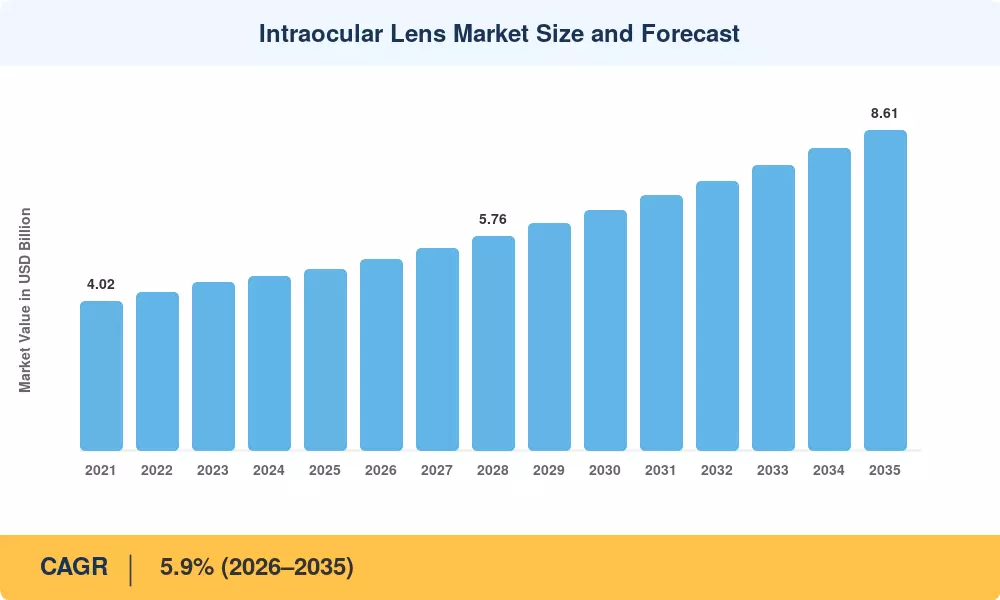
Intraocular Lens Market to Grow from USD 4.86 Billion in 2025 to USD 8.61 Billion by 2035—Powered by Rising Cataract Prevalence, Premium Optic Upgrades
NY, CA, UNITED STATES, September 9, 2026 /EINPresswire.com/ — As per Market Research Future, the global Intraocular Lens Market size is projected to reach USD 8.61 Billion by 2035 from USD 4.86 Billion in 2025, at a CAGR of 5.9% during the forecast period 2026–2035. The market opened the forecast window at USD 5.14 Billion in 2026.
The 5.9% CAGR—anchored by structural shifts in ophthalmic surgical care—is propelled by three converging forces: the rising global burden of cataract and vision impairment as populations age, with the prevalence of cataracts increasing dramatically with age and driving sustained growth in surgical procedure volumes; advancements in lens technology, particularly presbyopia-correcting, astigmatism-correcting, and extended depth-of-focus designs implanted through sub-2.4 mm incisions, which significantly improve patient outcomes and support premium upgrade economics; and the rapid expansion of ambulatory surgery centres, which now handle the majority of cataract procedures in developed markets and reward faster, standardised surgical workflows.
Global ophthalmic device companies and public health programmes are amplifying this momentum. Alcon, Johnson & Johnson MedTech, and Carl Zeiss Meditec collectively committed more than USD 3.1 billion to surgical R&D across 2023–2025, much of it directed at optic design, glistening-free materials, and biometry-to-implant digital workflows. India’s National Programme for Control of Blindness and Visual Impairment (NPCBVI) funds roughly 6.6 million cataract procedures annually, while the U.S. Centers for Medicare & Medicaid Services continues to reimburse cataract extraction with lens insertion as one of the highest-volume covered surgical procedures in the Medicare fee schedule. These forces are creating the surgical infrastructure and patient demand on which the Intraocular Lens Market depends.
Request A Free Sample:
https://www.marketresearchfuture.com/sample_request/7264
Key Market Trends & Growth Drivers
Rising Demand for Premium Optic Upgrades
The market is witnessing an increasing demand for presbyopia-correcting and astigmatism-correcting lens designs. As patients seek greater spectacle independence after cataract surgery, more individuals are opting for premium intraocular lenses. In the United States, patients typically pay out-of-pocket incremental charges of USD 1,800–3,500 per eye for the refractive upgrade above the Medicare-covered conventional lens, creating a functioning consumer market inside a public reimbursement system. Alcon continues expanding its premium portfolio through sustained innovation in toric, trifocal, and EDOF platforms.
Advancements in Lens Materials and Delivery Systems
Innovations in lens materials and delivery methods are becoming a hallmark of the industry. Manufacturers are refining hydrophobic acrylic chemistries, glistening-free materials, and preloaded injector systems that enable implantation through sub-2.4 mm incisions. These advancements aim to enhance surgical efficiency and refractive predictability, potentially leading to better visual outcomes and increased market penetration. Hydrophobic acrylic material accounted for approximately USD 3.02 Billion of 2025 revenue, reflecting near-universal surgeon preference in developed systems.
Expansion of Ambulatory Surgery Centres
The shift of cataract surgery into ambulatory settings is gaining traction. Ambulatory surgery centres contribute 44.0% of global procedure-linked lens revenue, with facility payment differentials versus hospital outpatient departments exceeding 40% per procedure in the United States. Shorter room turnover rewards preloaded injector systems and standardised biometry workflows. Johnson & Johnson MedTech continues strengthening its phacoemulsification-to-lens system integration to capture this channel.
Increasing Prevalence of Cataract and Vision Impairment
Ageing populations and rising cataract prevalence remain the primary demand driver. Global cataract surgical volume must roughly double by 2035 to keep pace with demographic need, according to WHO-referenced benchmarks, and the World Health Organization’s World Report on Vision underscores the urgent need for scalable surgical solutions. The market is projected to expand as public programmes—such as China’s provincial volume-based procurement rounds and Brazil’s SUS surgical campaigns—convert unmet need into funded procedure volume.
Ask for Customization:
https://www.marketresearchfuture.com/ask_for_customize/7264
Market Segment Insights
BY PRODUCT TYPE
Monofocal IOL: Largest segment with 61.5% share in 2025, remaining the default reimbursed option in publicly funded cataract programmes. Alcon maintains the broadest surgeon installed base across monofocal, toric, trifocal, and EDOF portfolios.
EDOF IOL: Fastest-growing segment at 10.2% CAGR, offering better intermediate vision than monofocals and fewer night-vision complaints than trifocals.
Multifocal / Trifocal IOL: Valued at USD 0.71 Billion in 2025, driven by strong spectacle-independence demand in patient-pay markets.
Toric IOL: Growing at 8.8% CAGR, supported by rising corneal astigmatism correction standards and improved rotational stability of current-generation platforms.
Accommodating / Adjustable IOL: Positioned as a novel premium tier, with light-adjustable systems enabling post-operative refractive fine-tuning.
BY MATERIAL TYPE
Hydrophobic Acrylic: Dominant material, generating USD 3.02 Billion of 2025 revenue, favoured for glistening-free chemistry and the lowest posterior capsule opacification rates in long-term series.
Hydrophilic Acrylic: 24% share in 2025, retaining a durable position in price-sensitive tenders and regions where injector cost matters as much as optic performance.
PMMA: 6.2% share, serving low-cost outreach programmes and paediatric applications.
Silicone: 3.5% share, representing a legacy installed base.
BY END USE
Ambulatory Surgery Centres: Largest segment with 44.0% share in 2025, benefiting from throughput economics and facility payment differentials. Physician-owners weigh per-case profitability directly and adopt premium optics faster.
Hospitals: Significant share at USD 1.85 Billion in 2025, handling complex cases and public system volume through committee-driven, price-anchored procurement.
Ophthalmology Clinics & Eye Institutes: Fastest-growing channel at 7.4% CAGR, driven by refractive lens exchange in pre-cataract patients and premium consultations.
BY SURGERY TYPE
Phacoemulsification: Dominant surgical technique, supported by the global shift toward micro-incision cataract surgery and preloaded delivery systems.
Extracapsular Cataract Surgery: Retains relevance in emerging markets with high-volume public programmes and manual small-incision surgical capability.
Intracapsular Cataract Surgery: Limited but persistent use in specific complex and trauma cases.
Read Detailed Insights:
https://www.marketresearchfuture.com/reports/intraocular-lens-market-7264
Regional Outlook
North America — Market Leader in Value
North America leads with 34.5% of global revenue in 2025, generating around USD 1.68 Billion. The region’s growth is driven by ambulatory surgery centre economics and patient-pay premium upgrades, with the United States holding 88.0% of the regional market. Medicare’s coverage architecture—conventional lens covered, refractive upgrade not—created a functioning consumer market inside a public reimbursement system. The competitive landscape is characterised by continuous innovation among leading ophthalmic device manufacturers.
Europe — Second Largest Market
Europe was valued at USD 1.31 Billion in 2025, representing the second-largest regional market. The region benefits from high premium-optic attach rates, particularly in Germany, where private supplementary insurance sustains one of the highest trifocal adoption rates worldwide. EU MDR recertification has consolidated supply toward larger manufacturers, quietly reducing the number of commercially available lens families. Leading countries include Germany, France, and the UK.
Asia-Pacific — Fastest-Growing Regional Segment
The Asia-Pacific region is the fastest-growing market, expanding at a 7.8% CAGR through 2035. Growth is propelled by Chinese and Indian surgical throughput, with China holding 33.5% of the regional market and India posting a 9.4% CAGR under NPCBVI tender volumes alongside a fast-growing private upgrade market. Japan maintains the highest per-capita cataract surgery rate globally, while China’s provincial volume-based procurement rounds have quadrupled targeted surgical volume while cutting average selling prices by 40–60%.
South America and Middle East & Africa — Emerging Potential
South America holds around 5.5% of the global share, led by Brazil’s SUS public surgery campaigns and private supplementary health plans. The Middle East & Africa region, valued at USD 0.17 Billion, is driven by Gulf medical tourism initiatives such as Saudi Vision 2030 hospital capacity programmes and NGO-funded outreach surgery across the African continent.
Competitive Landscape and Recent Developments
The Intraocular Lens Market is characterised by high concentration and steady technological advancement, driven by ageing populations and rising cataract surgical volumes worldwide. The top five suppliers hold an estimated 74–80% of global revenue, with the market moderately to highly consolidated.
KEY COMPANIES AND RECENT MILESTONES
Alcon (US/CH): Category leader with an estimated 28–32% revenue share. Offers the broadest full-portfolio coverage—monofocal, toric, trifocal, and EDOF—with preloaded delivery systems and the largest surgeon installed base.
Johnson & Johnson MedTech (US) (May 2024): Received expanded regulatory clearance for its presbyopia-correcting lens family in selected Asia-Pacific markets, accelerating premium availability. Holds an estimated 20–24% revenue share with strong phacoemulsification-to-lens system integration.
Carl Zeiss Meditec (DE) (September 2023): Integrated its biometry, surgical planning, and lens calculation stack into a single connected workflow, tightening the diagnostics-to-implant loop. Holds an estimated 7–9% revenue share.
Other Key Players: Bausch + Lomb (US/CA), HOYA Surgical Optics (JP), Rayner (GB), STAAR Surgical (US), Aurolab (IN), SIFI (IT), Ophtec (NL).
Market Development (November 2023): China’s NHSA provincial alliance completed a further volume-based procurement round covering intraocular lenses, extending price reductions across additional provinces.
Future Outlook: 2026–2035
The Intraocular Lens Market is projected to reach USD 8.61 billion by 2035, growing at a CAGR of 5.9%, driven by ageing populations, public cataract surgery programmes, and premium optic upgrade economics.
New opportunities lie in:
– Expansion into emerging markets with tailored mid-tier astigmatism-correcting lenses
– Development of light-adjustable optics and drug-eluting lens platforms
– Investment in biometry data services and digital surgical workflows for refractive accuracy
By 2035, the Intraocular Lens Market is expected to achieve substantial growth and innovation, with volume growth in Asia-Pacific and Africa complemented by premium-tier conversion in North America and Europe.
Related Reports:
https://www.marketresearchfuture.com/ja/reports/telemedicine-market-2216
https://www.marketresearchfuture.com/de/reports/telemedicine-market-2216
https://www.marketresearchfuture.com/fr/reports/surgical-robots-market-3025
https://www.marketresearchfuture.com/ja/reports/surgical-robots-market-3025
https://www.marketresearchfuture.com/de/reports/surgical-robots-market-3025
https://www.marketresearchfuture.com/es/reports/surgical-robots-market-3025
https://www.marketresearchfuture.com/zh-cn/reports/surgical-robots-market-3025
https://www.marketresearchfuture.com/ko/reports/surgical-robots-market-3025
https://www.marketresearchfuture.com/fr/reports/preclinical-cro-market-7274
https://www.marketresearchfuture.com/ja/reports/preclinical-cro-market-7274
Market Research Future
Market Research Future
+1 855-661-4441
email us here
Legal Disclaimer:
EIN Presswire provides this news content “as is” without warranty of any kind. We do not accept any responsibility or liability
for the accuracy, content, images, videos, licenses, completeness, legality, or reliability of the information contained in this
article. If you have any complaints or copyright issues related to this article, kindly contact the author above.

Media gallery