
Key Takeaways
- Content distribution means publishing your message across many platforms and formats simultaneously – not just posting on your own website and hoping for traffic.
- AI engines like ChatGPT and Perplexity prioritize information corroborated across independent sources, making multi-platform presence essential, not optional.
- Multi-channel campaigns using three or more channels drive up to 287% higher purchase rates than single-channel approaches, according to Omnisend (2020).
- Brands that tailor content to each platform’s format and tone often see significantly more engagement than those posting identical content everywhere.
- OmniCast, Leaf World Media’s proprietary distribution protocol, converts one topic brief into eight content formats deployed across 300+ platforms in 24-48 hours – a purpose-built solution for this exact challenge.
Most business owners assume a well-written blog post will eventually find its audience. Without active distribution, that rarely happens. The way content gets discovered has fundamentally changed, and the gap between brands that understand this and brands that don’t is widening fast.
Your Website Alone Won’t Get You Cited by AI
Search engines have always favored third-party validation over self-promotion, but AI engines take that principle even further. When ChatGPT, Perplexity, or Google AI Overviews formulate an answer, they aren’t just crawling your site – they’re scanning the broader web for corroboration. A brand that only exists on its own domain is a single, unverified data point. A brand that appears consistently across dozens of independent publications, video platforms, forums, and news outlets starts to look like a verified fact.
Think of it this way: if someone asked around about an unfamiliar business and only the business itself had anything to say, that’s a red flag. AI engines behave similarly. Industry analysis confirms that AI tools frequently prefer third-party sources over branded domains – which means broader distribution is the baseline requirement for AI visibility. A deeper breakdown of why this happens – and how to address it – is covered in this guide on what content distribution actually means in practice.
What Content Distribution Actually Means
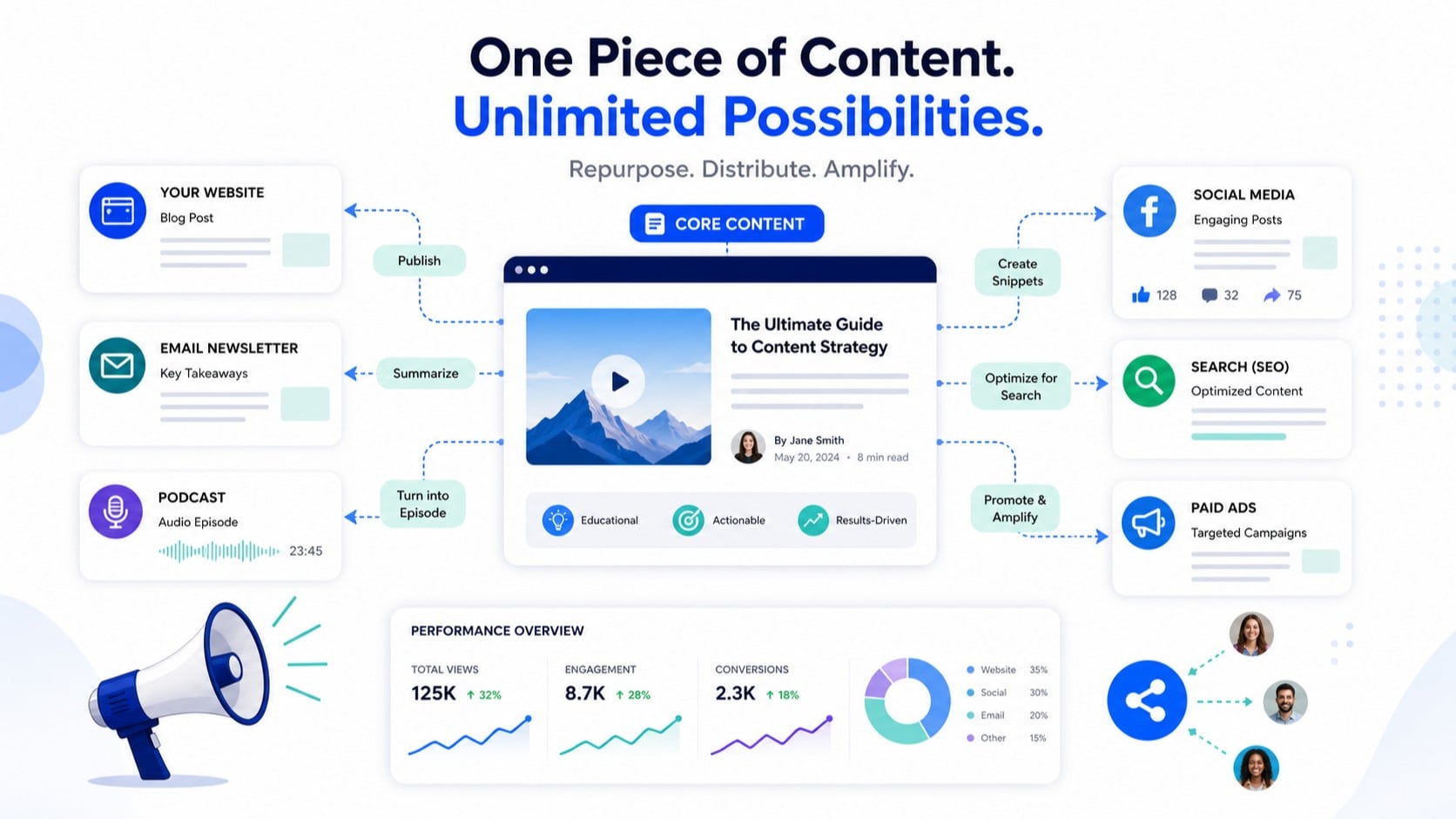
Content distribution is the process of publishing and sharing content across multiple platforms and channels – beyond your own website – so it reaches a wider audience and builds broader brand authority. Instead of one blog post living only on your domain, distributed content appears across news sites, blogs, podcasts, video platforms, and social channels at the same time.
Modern content distribution treats brand visibility as a continuous, multi-channel discipline rather than a one-time publishing event. The goal goes beyond reach – it’s the kind of consistent, independent corroboration that builds real authority over time.
Why AI Engines Demand Multi-Format Presence
AI engines don’t evaluate brands the way a human editor does. They build confidence through pattern recognition – specifically, by finding the same core facts about a brand repeated across many independent, authoritative sources. That process is called entity recognition, and it’s the mechanism behind which brands get cited and which get ignored.
Multi-format content is a key factor in what’s now called Answer Engine Optimization (AEO) because AI systems rely on diverse signals from blogs, videos, podcasts, and images to validate expertise and expand visibility across various search surfaces. A single blog post doesn’t trigger that confidence. A coordinated presence across hundreds of platforms does.
Corroboration Signals, Not Just Backlinks
Traditional SEO focused heavily on backlinks – the number of other sites pointing back to yours. AI visibility works differently. What matters is whether independent sources are saying consistent things about your brand. A scattered, contradictory presence can actually confuse entity recognition rather than strengthen it. Coordinated distribution – where the same core message appears across every format and platform – is what builds the trust AI engines act on.
Reddit, YouTube, and LinkedIn Already Drive the Majority of AI Citations
The platforms AI engines draw from most aren’t always the obvious ones. According to research by Originality.AI (2023), Reddit accounts for a substantial share of AI-related citations, with YouTube and LinkedIn contributing heavily as well. Quora, Pinterest, and podcast directories round out the picture. A brand with no presence on these platforms is effectively invisible to the AI systems making recommendations to potential customers right now.
Format-Fit: Why Identical Posts Underperform
Publishing the same block of text across every platform is repetition, not distribution. Each platform has its own audience expectations, algorithmic preferences, and content norms. A press release that works on a wire service reads nothing like a script built for a short-form video, and content that ignores those differences consistently underperforms.
Platform-Tailored Content Drives Higher Engagement
Brands that customize content for each platform often see significantly more engagement than those posting identical content across all channels. That gap compounds over time – more engagement means more algorithmic distribution, which means more indexing, which means more AI citations. Format-fit is a multiplier on every distribution effort.
The 8 Formats That Cover Every Surface AI Indexes
A strong strategy doesn’t pick one or two formats and stop there. The surfaces AI engines index are varied, and covering all of them requires a deliberate mix:
- Press releases – distributed to news outlets and wire networks; the trust signal AI models prioritize first
- Expert blog posts – long-form SEO content on authority sites beyond your own domain
- Interview podcasts – audio content distributed across Spotify, Apple Podcasts, and Amazon Music
- Long-form video – published to YouTube and Vimeo for high-intent research traffic
- Short-form video – scroll-friendly clips for TikTok, Instagram Reels, and YouTube Shorts
- Infographics – visual summaries easily scraped and cited by AI research tools
- Digital flipbooks – interactive publications on SlideShare and AnyFlip that AI models cite as definitive documents
- Social posts – platform-native content across Facebook, LinkedIn, and X proving active presence everywhere at once
The Business Case Is No Longer Debatable
The data behind multi-channel content strategies isn’t speculative anymore. The numbers are clear, and they apply directly to brands of any size.
Up to 287% Higher Purchase Rates With Multi-Channel Campaigns
According to Omnisend (2020), multi-channel campaigns using three or more channels achieve 287% higher purchase rates than single-channel approaches. Brands using five or more coordinated channels see that figure climb to 412% higher purchase rates. A significant majority of marketers report increased ROI after adopting a multi-channel approach, and a high percentage of brands already use three or more marketing channels. The gap between brands doing this and brands that aren’t is already significant – and it’s growing.
Greater Customer Retention From Multi-Channel Consistency
Reach isn’t the only payoff. Businesses that adopt a multi-channel strategy often achieve significantly greater customer retention compared to those that don’t. Consistent visibility across platforms reinforces brand familiarity, and brand familiarity is what turns a first-time buyer into a repeat customer. The distribution strategy that wins new leads is the same one that keeps existing customers engaged.
Traditional PR vs. Distribution at Scale
Traditional PR and modern content distribution solve a similar problem – getting a brand seen – but they approach it very differently. Traditional PR is relationship-based: pitching a small number of outlets, waiting for coverage, and hoping the story lands. It’s effective for major announcements but slow, limited in scale, and hard to repeat consistently.
Content distribution at scale is built for a different job entirely. Multiple formats get placed simultaneously across hundreds of platforms in 24-48 hours. Full placement reports with live links replace the guesswork of traditional coverage tracking. Neither approach fully replaces the other – a major funding round still warrants a targeted PR push – but for the ongoing, repeatable work of building AI and search visibility, distribution at scale is the right tool.
How OmniCast Turns One Brief Into Multi-Platform Authority
Understanding the strategy is one thing. Executing it consistently – across eight formats, hundreds of platforms, every campaign – is where most marketing teams hit a wall. That’s the operational problem OmniCast, Leaf World Media’s proprietary distribution protocol, is built to solve.
Eight Formats, Hundreds of Platforms, One Submission
The OmniCast process starts with a single topic brief that takes about 10 minutes to complete. From there, Leaf World Media’s team builds all eight content formats – press release, expert blog post, podcast, long-form video, short-form video, infographic, digital flipbook, and social posts – each tailored to the platform it’s built for. All eight go live across 300+ high-authority platforms simultaneously, within 24 hours. That synchronized wave of brand mentions is exactly the kind of corroboration signal AI engines are trained to trust.
Measuring Real Results: Citations, Domains, and AI Mentions
Every OmniCast campaign delivers a full placement report with live links to every platform the content was published on – permanent assets, not disappearing ads. Beyond placement confirmation, the signals worth tracking over time include referring domain growth, direct AI citation testing (asking tools like ChatGPT relevant industry questions to see whether the brand surfaces), and search visibility trends as campaigns accumulate. Results build gradually – based on Leaf World Media’s experience, strong AI citation patterns typically develop over a period of consistent campaigns – which is exactly why ongoing distribution outperforms any single event.
Consistency Beats Any Single Campaign – Start Building Your Footprint
The most common mistake brands make with content distribution is treating it as a one-time event. A single burst of placements creates a short-term signal that fades. Consistent, regular campaigns are what build compounding authority – the kind that keeps a brand visible in AI answers, search results, and customer awareness month after month.
The brands winning in AI-driven search right now aren’t necessarily the ones with the biggest budgets. They’re the ones showing up everywhere, consistently, in the formats each platform actually rewards. That’s the footprint worth building – and the sooner it starts, the harder it becomes for competitors to catch up.
For businesses ready to stop waiting for traffic and start building authority across the web, Leaf World Media LLC specializes in exactly this – turning single campaign briefs into multi-platform brand presence that AI engines recognize and cite.
Leaf World Media LLC
jerry@LeafWorldMedia.com
+1-718-640-2855
Woehrle ave
Staten Island
New York
10312
United States


