Emily Jones for Grist
How one stateâs hunters are taking aim at rural hunger
On the outskirts of Savannah, Georgia, a line of large chest coolers waits outside Wise Brothers Processing. Inside them, skinned deer lie packed in ice, ready to be cut into cubes, ground up, or made into sausage, depending on the customerâs order. Once ready, the meat is wrapped and placed in the freezer for the hunters to take back home.
This is all pretty standard for deer hunters, the way animals they shoot become meat to feed their families. But a lot of this meat isnât going back to the hunters who brought it â itâs bound for a soup kitchen in the heart of Savannah.
âThe charity that we use, they feed 250-plus people, three times a day,â said Debra Wise, who runs the business along with the rest of her family. Theyâve sent 500 pounds of ground venison to Old Savannah City Mission so far this year, she told Grist.
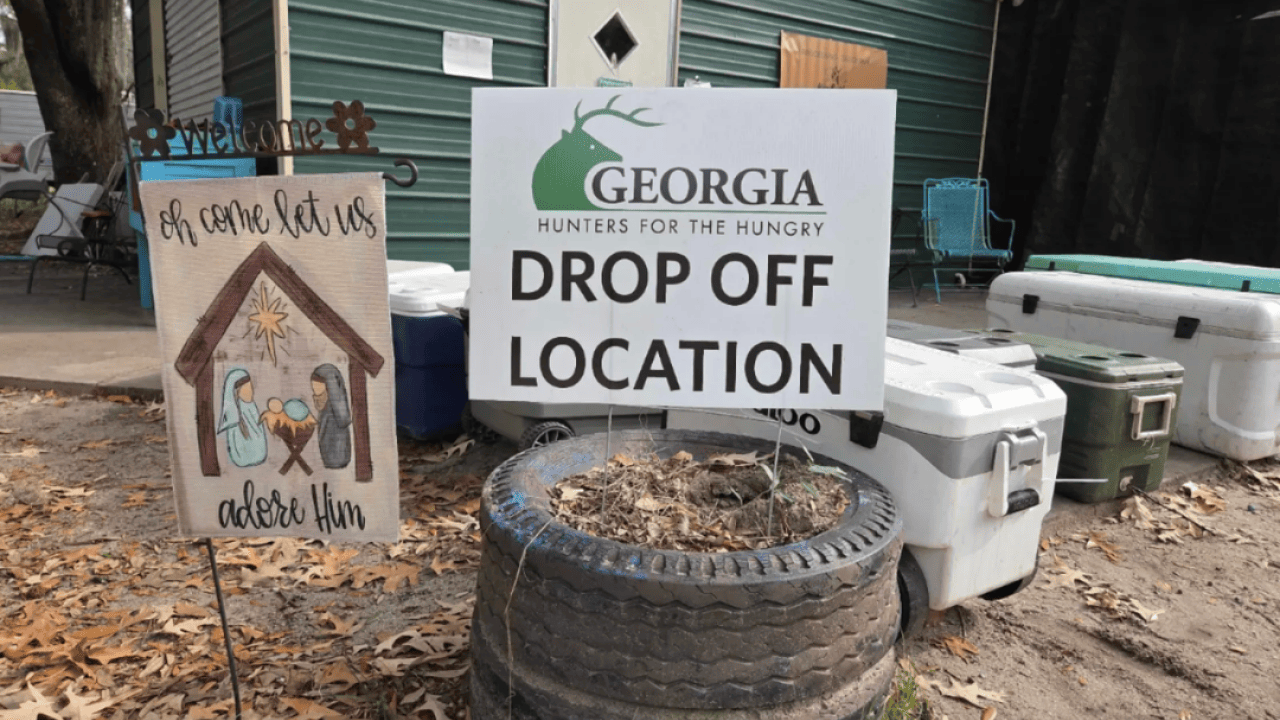
The Wises are taking part in the Georgia Wildlife Federationâs Hunters for the Hungry program. Georgia hunters are allowed to kill up to 12 deer in a year, but many donât have the freezer space to keep them all or donât need that much meat to feed their families. Hunters for the Hungry allows them to donate the extra. The state recently increased funding to $350,000 annually, allowing the program to expand from six processors to 56 and add freezer trailers to store additional meat. This year, the program has set a goal of collecting 140,000 pounds of donations, which the state Department of Natural Resources estimates can feed 560,000 people.
âThey reached out to us and asked us if we would be interested in accepting the deer for the hunter program, and of course we jumped right on it,â Wise said. âAnything to help someone out, weâre all about it.â
Each processor donates the meat and distributes it within their local community. Hunters for the Hungry isnât specifically designed to address rural hunger, and some meat â including the Wise Brothersâ â goes to city-based charities. But since most processors are located out in the country, where the hunting is, a lot of the donations end up staying there.
Across Georgia, nearly 15% of families are food insecure, meaning they have limited or uncertain access to adequate food, according to Feeding America. Some of the highest rates are in rural counties. Rural Hancock County, nestled between Atlanta and Augusta, has the highest rate in the country of children facing food insecurity, at 47%. Nationwide, 86% of counties with the highest food insecurity rates are rural.
The hunger rates in rural areas stand in contrast to the amount of food produced there. For example, in Georgia agriculture is the biggest industry. The state is first in the country for broiler chickens, hatching eggs, and peanuts, and produces significant amounts of beef, dairy, corn, and blueberries. But most of that food is produced at a large scale to supply the wider U.S. food system, going to processors and distributors before reaching grocery stores, which means the majority of people who grow food and farm animals have to rely on grocery stores to buy their food just like people in big cities.
âNot every county or not every region has all these different products, so we rely on a food system that is able, through processing and retail, to combine all these products for the benefit of consumers,â said University of Georgia professor Vanessa Shonkwiler, who studies local food systems. âBut then back to our rural food insecurity â this food system is not necessarily able to reach everyone.â
Collective reliance on that system also means impacts of climate change â even in other parts of the country or elsewhere in the world â can further undermine food security by disrupting supply chains and making prices more volatile.
âThereâs not necessarily a recipe that we can apply here and there,â Shonkwiler said. Because people are so spread out in rural areas, she added, typical solutions like food pantries arenât always effective.
âOne size doesnât fit all. And itâs really the collaboration between different entities that makes it work or doesnât,â Shonkwiler said.
Nonprofits, churches, universities, and other groups have taken many approaches to rural hunger. Some of Shonkwilerâs students recently conducted feasibility studies of different models, including a small neighborhood grocery store and a mobile grocery truck. Some nonprofits actually run small grocery stores. Another organization Shonkwiler works with is preparing to try out a model thatâs worked in Europe, in which a self-service grocery store is set up in a shipping container for people to access essentials without the added expense of staffing.
The common thread to efforts that succeed, Shonkwiler said, is the level of buy-in from local leaders and the community, who need to be invested in the solution for it to work.
But even working models are now struggling after the 43-day government shutdown halted funding that food-aid organizations count on. âItâs directly the survival of the nonprofit here that is at stake,â Shonkwiler said.
Some have had to shut down stores or programs that serve rural Georgia, at least temporarily, so they can keep feeding people in the long term. Other federal funding cuts have hit rural food programs, too. The U.S. Department of Agricultureâs Childcare Access and Nutrition Systems grant program, for instance, funded a food bank, a farmers market, a mobile kitchen, and other programs in rural southwest Georgia â but it was canceled earlier this year, according to Georgia Senator Jon Ossoffâs office.
For people in food deserts, living at least 10 miles from any supermarket and struggling to make ends meet, that means resources theyâve come to count on may not be available this holiday season.
But rural Georgians are finding other ways to help each other out. Beyond the state-sponsored Hunters for the Hungry program, Wise Brothers Processing often donates meat to families in need. Recently, Wise said, a local church contacted them about a family with a sick child who needed some help. Theyâve sent the family venison, and plan to send more soon.
âThat brings joy to our hearts, to know that weâre able to help someone else when weâve had to have help before, too,â Wise said. âItâs just, you know, the Lord has blessed us and weâd like to bless in return.â
This coverage is made possible through a partnership between Grist and WABE, Atlantaâs NPR station.
This story was produced by Grist and reviewed and distributed by Stacker.


