
The Business Research Company’s Central Precocious Puberty Global Market Report 2026 – Market Size, Trends, And Forecast 2026-2035
LONDON, GREATER LONDON, UNITED KINGDOM, November 24, 2026 /EINPresswire.com/ — The treatment landscape for central precocious puberty (CPP) has experienced notable advancements recently, driven by both medical innovation and growing awareness. As healthcare systems adapt to better manage early puberty onset, the market for CPP treatments is positioned for substantial growth in the coming years. Here’s an overview of the market size, key drivers, regional outlook, and emerging trends shaping this important healthcare segment.
Forecasted Market Size and Growth Trajectory of the Central Precocious Puberty Treatment Market
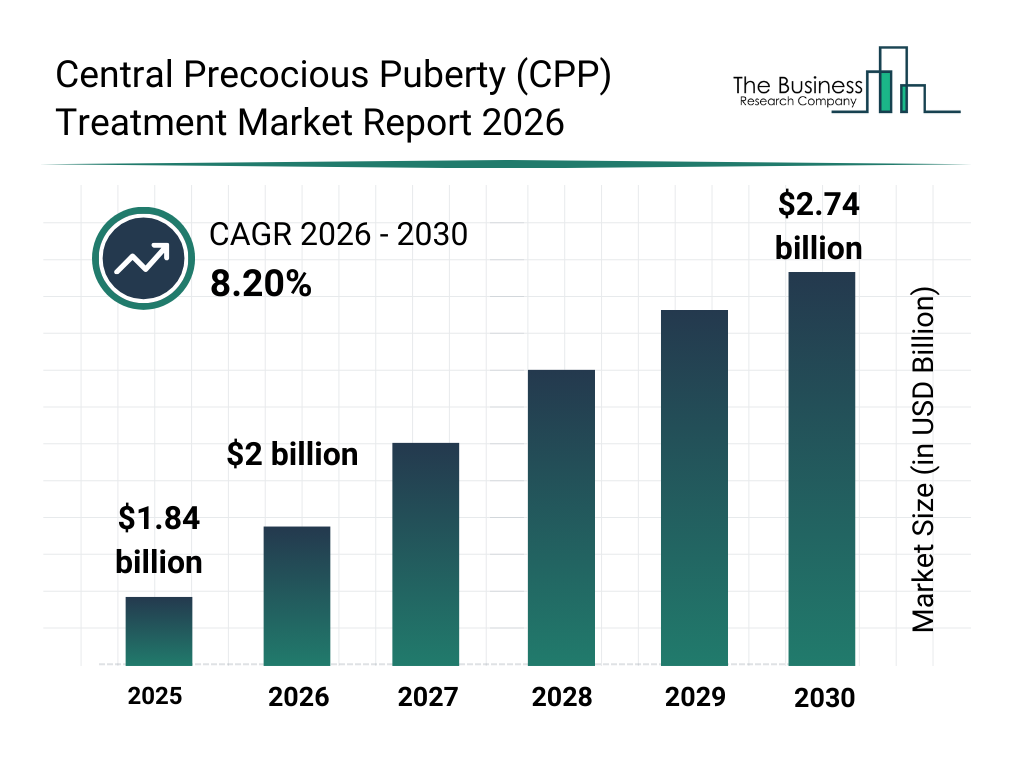
The central precocious puberty treatment market has demonstrated robust growth over recent years. From a valuation of $1.84 billion in 2025, it is expected to rise to $2 billion in 2026, reflecting a compound annual growth rate (CAGR) of 8.5%. This historical growth has been influenced by factors such as limited treatment alternatives for CPP, insufficient awareness regarding early puberty management, a growing pediatric population, expanding hospital and clinical infrastructure, and continued reliance on conventional hormonal therapies.
Download a free sample of the central precocious puberty (cpp) treatment market report:
https://thebusinessresearchcompany.com/sample_request?id=65519062&type=smp&name=Central%20Precocious%20Puberty%20%28CPP%29%20Treatment%20Market%20Report%202026&utm_source=EINPresswire&utm_medium=Paid&utm_campaign=Nov_PR
Looking ahead, the market is projected to expand further, reaching $2.74 billion by 2030. This corresponds to a slightly moderated but still strong CAGR of 8.2%. Growth during this forecast period will largely be driven by the introduction of novel GnRH-based treatments, the integration of digital monitoring technologies, increased specialization in pediatric endocrinology, government healthcare initiatives, and the expansion of homecare and telemedicine services. Key trends include greater awareness of early CPP diagnosis, wider adoption of GnRH agonists and antagonists, personalized hormonal therapy approaches, the rise of specialty clinics, and the integration of remote patient monitoring solutions.
Understanding Central Precocious Puberty and its Treatment Approach
Central precocious puberty refers to the early development of secondary sexual characteristics, occurring before age 8 in girls and before age 9 in boys, caused by premature activation of the hypothalamic-pituitary-gonadal (HPG) axis. The standard medical intervention involves the use of gonadotropin-releasing hormone (GnRH) agonists, which suppress early sex hormone secretion to delay or halt puberty progression. These treatments aim to regulate hormone levels and prevent the physical and psychological effects associated with early puberty onset.
View the full central precocious puberty (cpp) treatment market report:
https://thebusinessresearchcompany.com/report/central-precocious-puberty-cpp-treatment-global-market-report?utm_source=EINPresswire&utm_medium=Paid&utm_campaign=Nov_PR
Key Factors Fueling Growth in the Central Precocious Puberty Treatment Market
A significant driver behind the expansion of the CPP treatment market is the rising prevalence of hormonal disorders worldwide. Hormonal imbalances can lead to a variety of health conditions influenced by factors such as obesity, which disrupts insulin, estrogen, and leptin regulation. Disorders linked to these hormone imbalances include diabetes, thyroid dysfunction, and reproductive issues. CPP treatments address these concerns by controlling early hormone overproduction and normalizing developmental timelines.
For example, in February 2025, the World Health Organization highlighted that polycystic ovary syndrome (PCOS), one of the most common hormonal disorders in women of reproductive age, affects approximately 6 to 13 percent of this population, with up to 70 percent of cases remaining undiagnosed. This underscores the growing burden of hormonal diseases globally, which in turn stimulates demand for CPP therapies that help restore hormonal balance and improve patient outcomes.
Regional Market Leadership and Outlook for Central Precocious Puberty Treatment
In 2025, North America held the largest share of the central precocious puberty treatment market, benefiting from advanced healthcare infrastructure and awareness. However, the Asia-Pacific region is expected to record the fastest growth during the forecast period due to rising healthcare investments, increasing pediatric populations, and expanding access to specialized medical care. The market report encompasses various key regions including Asia-Pacific, South East Asia, Western Europe, Eastern Europe, North America, South America, the Middle East, and Africa, providing a comprehensive global perspective.
Our 2026 market reports now feature expanded strategic intelligence through market attractiveness scoring and analysis, total addressable market (TAM) analysis, company scoring matrix graphics and tables, Excel-based dashboards, market hotspots infographics, key technology and future trend analysis, along with updated graphics and tables.
Speak With Our Expert:
Saumya Sahay
Americas +1 310-496-7795
Asia +44 7882 955267 & +91 8897263534
Europe +44 7882 955267
Email: marketing@tbrc.info
The Business Research Company – www.thebusinessresearchcompany.com
Follow Us On:
• LinkedIn: https://in.linkedin.com/company/the-business-research-company“
Oliver Guirdham
The Business Research Company
+44 7882 955267
info@tbrc.info
Visit us on social media:
LinkedIn
Facebook
X
Legal Disclaimer:
EIN Presswire provides this news content “as is” without warranty of any kind. We do not accept any responsibility or liability
for the accuracy, content, images, videos, licenses, completeness, legality, or reliability of the information contained in this
article. If you have any complaints or copyright issues related to this article, kindly contact the author above.

Media gallery