The Business Research Company’s Competitive Analysis of Artificial Intelligence Global Market Report 2026 – Market Size, Trends, And Forecast 2026-2035
LONDON, GREATER LONDON , UNITED KINGDOM, October 26, 2026 /EINPresswire.com/ — The rapid incorporation of artificial intelligence (AI) into urban development is revolutionizing how cities operate and serve their residents. As smart cities evolve, AI applications are playing an increasingly pivotal role in managing infrastructure, resources, and public services efficiently. Examining current market trends and forecasts offers insight into the dynamic growth and opportunities within this sector.
Market Size and Position of Artificial Intelligence Applications for Smart Cities
The artificial intelligence (AI) applications for smart cities market is anticipated to exceed $40 billion by 2030. This market is a subset of the broader Smart Cities industry, which is projected to reach around $2,210 billion by the same year. AI applications will represent roughly 2% of that parent market. Within the larger Information Technology sector, expected to be valued at $13,788 billion by 2030, the AI for smart cities segment will make up approximately 0.3% of the total market.
Request A Free Sample Of The Artificial Intelligence (AI) Applications For Smart Cities Market Report
https://thebusinessresearchcompany.com/sample_request?id=69321251&type=smp&name=Artificial%20Intelligence%20%28AI%29%20Applications%20For%20Smart%20Cities%20Market%20Report%202026&utm_source=EINPresswire&utm_medium=Paid&utm_campaign=Oct_PR
North America as the Leading Region in AI for Smart Cities by 2030
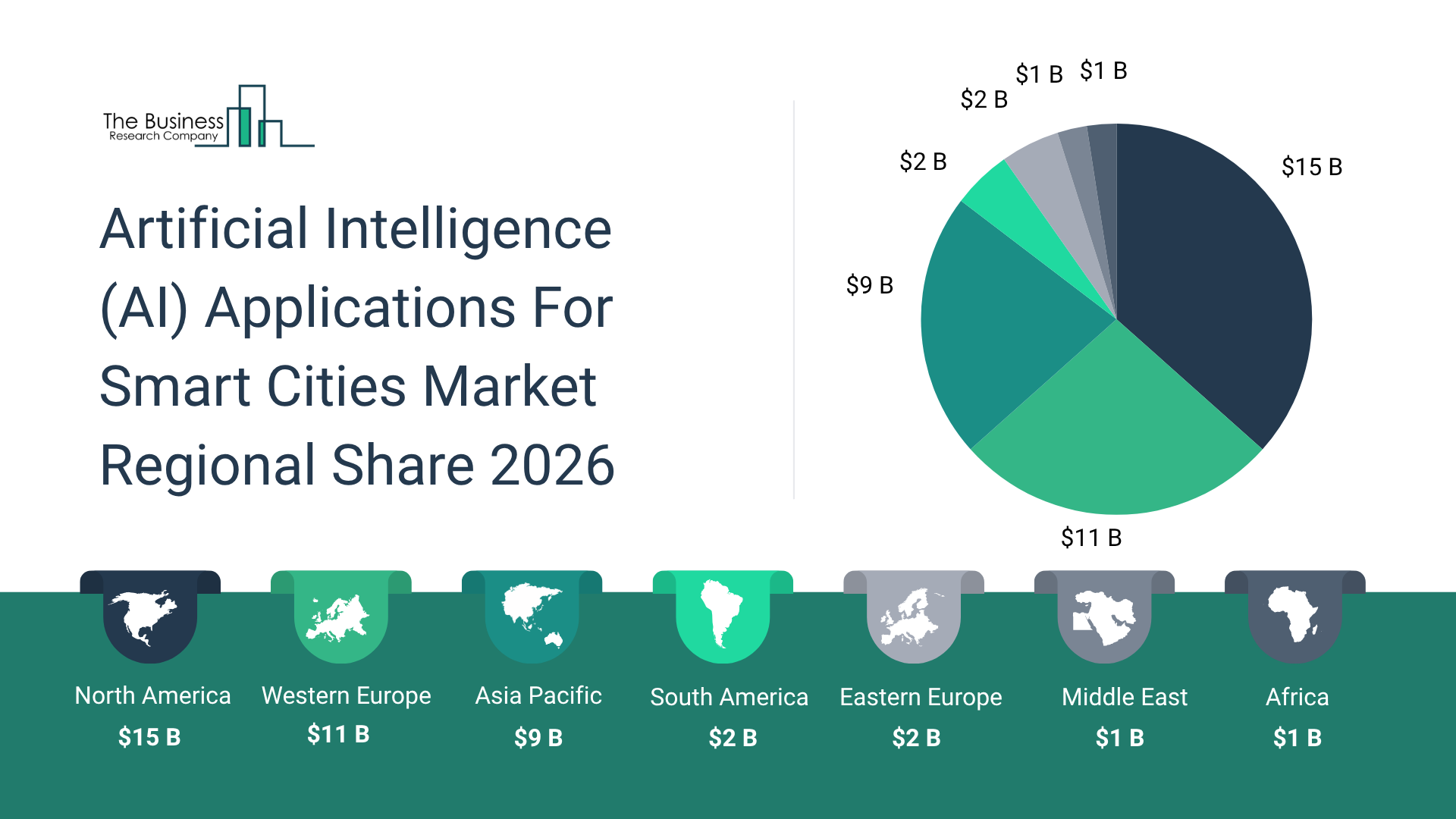
By 2030, North America is set to be the largest regional market for artificial intelligence applications in smart cities, valued at $14.9 billion. The market value is expected to grow from $6.3 billion in 2025, demonstrating a strong compound annual growth rate (CAGR) of 19%. This expansion is driven by widespread adoption of AI-enabled urban management tools, increased investments to upgrade smart infrastructure, deployment of connected sensors, enhanced digital public services, and collaborative efforts among technology vendors, governments, and research bodies to advance smart city initiatives in the region.
Dominant Country in the AI for Smart Cities Market: The United States
The United States is projected to dominate the global AI applications market for smart cities by 2030, with an estimated worth of $13.2 billion. This growth stems from its market size of $5.6 billion in 2025, growing at a CAGR of 19%. Key factors include extensive use of AI-driven traffic and public safety systems, increased investments in intelligent transportation and digital infrastructure, growing reliance on predictive analytics for city operations, greater demand for real-time municipal decision-making, and continuous innovation by leading technology firms aiming to optimize urban efficiency and enhance citizen experiences.
Access The Detailed Artificial Intelligence (AI) Applications For Smart Cities Market Report Here
https://thebusinessresearchcompany.com/report/artificial-intelligence-ai-applications-for-smart-cities-market-report?utm_source=EINPresswire&utm_medium=Paid&utm_campaign=Oct_PR
Leading Segment within the AI Applications for Smart Cities Market
When broken down by type, the market segments into safety and security, mobility and transportation, energy and resource management, infrastructure management, and healthcare. The mobility and transportation segment is expected to be the largest, accounting for 32% of the market or $13 billion in 2030. Growth in this segment will be fueled by the adoption of AI-powered traffic management platforms, connected and autonomous mobility solutions, real-time public transit optimization, smart parking and congestion systems, and ongoing investments in smart mobility ecosystems designed to improve transport efficiency and reduce pollution in urban areas.
Technology and Deployment Segments in the AI for Smart Cities Market
The market is categorized by deployment methods into cloud-based and on-premises solutions. Additionally, it is segmented by technology into machine learning, computer vision, IoT integration, and big data analytics. Application-wise, the market covers both big cities and medium/small cities, each with unique demands and growth potentials.
Expected Growth Rate Through 2030
The artificial intelligence applications for smart cities market is forecasted to expand at an impressive compound annual growth rate (CAGR) of 20% leading up to 2030, reflecting rapid acceptance and integration of AI-driven urban solutions globally.
Primary Factors Fueling Market Expansion
Rising Urbanization and Population Density
One of the strongest drivers behind market growth is the increasing urbanization and population density worldwide. As metropolitan areas expand, there is greater demand for intelligent digital platforms that can coordinate complex city functions such as transportation networks, utility management, emergency responses, and public infrastructure. AI-powered analytics equip city officials with the tools to monitor urban activities, predict service needs, and boost operational efficiency, particularly in densely populated environments. The complexity of managing modern cities encourages municipalities to implement sophisticated AI solutions to enhance responsiveness and facilitate long-term urban planning. This factor alone is expected to add about 2.0% annual growth to the market.
Government Support Through Smart City Initiatives
Public sector investments in smart city development programs also significantly contribute to market growth. Governments worldwide are increasingly funding digital transformation efforts aimed at modernizing civic infrastructure using intelligent technologies and connected platforms. AI adoption is accelerating to improve administrative operations, enhance public services, and enable data-driven governance within urban ecosystems. These well-funded, strategic projects are facilitating the rollout of advanced AI capabilities in municipal functions, contributing approximately 1.5% annual growth to the market.
Sustainability Needs Driving AI Use in Urban Environments
Another key growth catalyst is the growing emphasis on sustainable resource management. Cities are under pressure to optimize energy and resource use, and AI technologies are instrumental in achieving these goals through intelligent monitoring, forecasting, and automated adjustments. By identifying inefficiencies and enabling proactive management of urban assets, AI solutions help municipalities meet sustainability targets while reducing operational expenses. As cities prioritize environmentally responsible development and resilience, adoption of AI-enabled resource management platforms is predicted to add roughly 1.3% per year to market growth.
Emerging Market Opportunities in AI for Smart Cities
Among various sectors, safety and security, mobility and transportation, energy and resource management, infrastructure management, and healthcare are expected to offer the most substantial growth potential. Together, these segments are forecasted to contribute over $24 billion in market value by 2030. This surge is propelled by the increasing use of AI-powered automation across urban services, expanded deployment of connected infrastructures, growing demand for real-time operational insights, broader integration of predictive analytics in municipal decision-making, and ongoing advancements in intelligent city management platforms. This trend highlights a widespread commitment to enhancing urban resilience, improving citizen experiences, and fostering data-driven city ecosystems.
Segment Growth Breakdown from 2025 to 2030
The safety and security segment is projected to grow by $6 billion, mobility and transportation by $8 billion, energy and resource management by $4 billion, infrastructure management by $3 billion, and healthcare by $3 billion over the five-year period. The market features a blend of major global technology corporations and specialized firms focused on AI, cloud computing, and urban digital infrastructure. These companies are prioritizing intelligent traffic solutions, AI-based public safety systems, predictive infrastructure analytics, urban data integration, and edge-enabled smart city applications to strengthen their positions. Key factors for competitiveness include scalable AI implementation, robust data security, operational efficiency, interoperability across platforms, and adherence to evolving regulations.
Top Market Leader in AI Applications for Smart Cities
Microsoft Corporation stands out as the market leader, holding a 3% share of global sales in 2025. Its broad ecosystem encompassing intelligent cloud services, AI platforms, urban digital twins, IoT frameworks, and generative AI solutions plays a central role in enabling city operations, resource management, and data-driven decision-making across connected urban environments.
Major Companies Operating in the Market
The AI applications for smart cities market features several prominent players, including Microsoft Corporation, Huawei Technologies Co. Ltd, Cisco Systems, Inc., International Business Machines Corporation, Siemens AG, Schneider Electric SE, ABB Ltd., Hitachi Ltd., Infosys Limited, PTC Inc., Larsen & Toubro Limited, Verkada Inc., HCL Technologies Limited, Ubicquia Inc., Utilidata Inc., Optibus Ltd., Seoul Robotics Inc., Gorilla Technology Group Inc., Ekin Smart City Technologies Inc., Nodeflux Inc., Ecube Labs Co. Ltd., and Enevo Oy.
Market Concentration and Competitive Landscape
The market remains moderately fragmented, with the top 10 companies accounting for 19% of total revenue in 2025. This distribution reflects the technological complexity and challenges associated with deploying scalable AI solutions in urban infrastructure modernization, system interoperability, and ensuring secure, scalable digital platforms. Leading players maintain significant shares through comprehensive AI offerings, cloud-based smart city products, advanced analytics, extensive public sector collaborations, and global expertise in digital infrastructure. As demand for intelligent urban services, connected mobility, predictive management, AI-powered safety, and sustainable infrastructure grows, continued innovation, strategic partnerships, and expanded deployments will bolster their competitive advantages.
Key Suppliers of Raw Materials for AI Solutions
The supply chain for AI hardware and related technologies includes major companies such as NVIDIA Corporation, Advanced Micro Devices Inc., Intel Corporation, Qualcomm Incorporated, Micron Technology Inc., Samsung Electronics Co. Ltd, SK hynix Inc., Taiwan Semiconductor Manufacturing Company, GlobalFoundries Inc., Broadcom Inc., Marvell Technology Inc., Arm Holdings plc, Cadence Design Systems Inc., Synopsys Inc., Corning Incorporated, TE Connectivity Ltd., Amphenol Corporation, STMicroelectronics N.V., and Infineon Technologies AG.
Leading Wholesalers and Distributors in the AI for Smart Cities Sector
Prominent distributors facilitating market reach include TD SYNNEX Corporation, Ingram Micro Holding Corporation, Arrow Electronics Inc., Avnet Inc., Westcon-Comstor, Redington Limited, Exclusive Networks SA, ScanSource Inc., ALSO Holding AG, Synnex Technology International Corporation, Tech Data Corporation, WPG Holdings Limited, Esprinet S.p.A., Mitsui & Co. Ltd., Itochu Corporation, Marubeni Corporation, Sonepar Group, Rexel S.A., and WESCO International Inc.
End Users Benefiting from AI Applications in Smart Cities
Major end users encompass utilities and infrastructure companies such as Veolia, ENGIE, Enel, EDF Group, National Grid plc; telecom operators including Deutsche Telekom AG, Telefónica S.A., Verizon Communications Inc., AT&T Inc., BT Group plc; as well as infrastructure and real estate firms like Adani Airports Holdings Limited, GMR Airports Limited, DP World, PSA International, Prologis Inc., Goodman Group, CapitaLand Investment Limited, and Mitsui Fudosan Co. Ltd.
Key Market Trends Transforming Smart City AI Applications
AI-powered location intelligence platforms are leading innovations by enabling real-time urban data analysis, enhancing infrastructure planning, and supporting data-driven decisions across interconnected city systems. For example, in August 2024, Nearmap Pty Ltd. introduced Generation 6 (Gen 6), a significant upgrade to its location intelligence platform featuring over 130 AI-derived detections and scoring capabilities applied to high-resolution aerial imagery. This advanced geospatial analytics tool facilitates improved urban planning, infrastructure management, and efficient public service delivery within smart city frameworks.
Strategies Adopted by Companies to Maintain Market Leadership
To stay competitive, companies are investing in AI-driven digital twin platforms that enhance urban infrastructure planning, integrating edge AI technologies for improved real-time operations, expanding intelligent traffic management with predictive AI systems, forming strategic partnerships to accelerate connected smart city ecosystems, and advancing generative AI applications to automate public service delivery. These approaches aim to optimize efficiency, scalability, and innovation in the rapidly evolving smart cities market.
What’s new in our 2026 market reports:
• Market attractiveness scoring and analysis
• Total addressable market (TAM) analysis
• Company scoring matrix graphics and tables
• Excel dashboards
• Market hotspots infographics
• Key technologies and future trends
• Updated graphics and tables
Learn More About The Business Research Company
The Business Research Company (www.thebusinessresearchcompany.com) is a leading market intelligence firm renowned for its expertise in company, market, and consumer research. We have published over 30,000+ reports across 27 industries and 60+ geographies. Our research is powered by 1,500,000 datasets, extensive secondary research, and exclusive insights from interviews with industry leaders.
We provide continuous and custom research services, offering a range of specialized packages tailored to your needs, including Market Entry Research Package, Competitor Tracking Package, Supplier & Distributor Package and much more.
Disclaimer: Please note that the findings, conclusions and recommendations that TBRC Business Research Pvt Ltd delivers are based on information gathered in good faith from both primary and secondary sources, whose accuracy we are not always in a position to guarantee. As such TBRC Business Research Pvt Ltd can accept no liability whatever for actions taken based on any information that may subsequently prove to be incorrect. Analysis and findings included in TBRC reports and presentations are our estimates, opinions and are not intended as statements of fact or investment guidance.
Contact Us:
The Business Research Company
Americas +1 310-496-7795
Europe +44 7882 955267
Asia & Others +44 7882 955267 & +91 8897263534
Email: marketing@tbrc.info
Follow Us On:
LinkedIn: https://in.linkedin.com/company/the-business-research-company.
Oliver Guirdham
The Business Research Company
+44 7882 955267
info@tbrc.info
Visit us on social media:
LinkedIn
Facebook
X
Legal Disclaimer:
EIN Presswire provides this news content “as is” without warranty of any kind. We do not accept any responsibility or liability
for the accuracy, content, images, videos, licenses, completeness, legality, or reliability of the information contained in this
article. If you have any complaints or copyright issues related to this article, kindly contact the author above.

Media gallery